2026-04-21 九州工業大学
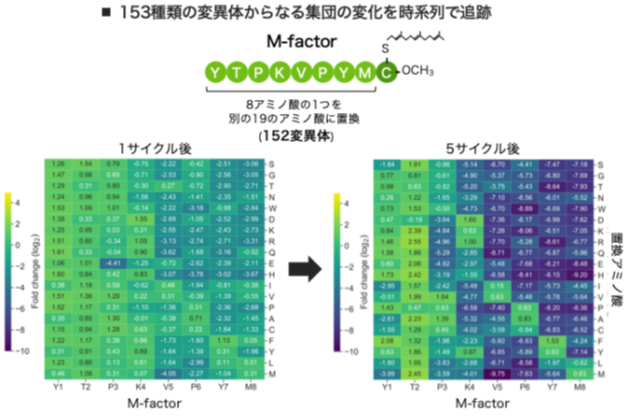
図1. 性フェロモンが多様化しうる環境条件の探索
<関連情報>
- https://www.kyutech.ac.jp/whats-new/press/entry-12062.html
- https://www.nature.com/articles/s42003-026-10058-6
分裂酵母における交配フェロモンの文脈依存的な活性化と進化的な緩衝作用 Context-dependent activation and evolutionary buffering of a mating pheromone in fission yeast
Taisuke Seike,Natsue Sakata,Hazuki Kotani & Chikara Furusawa
Communications Biology Published:21 April 2026
DOI:https://doi.org/10.1038/s42003-026-10058-6
Abstract
The evolution of mating signals drives reproductive isolation and speciation across diverse lineages. However, how short peptide pheromones, typically subject to strong structural constraints, achieve functional diversification remain unclear. In the fission yeast Schizosaccharomyces pombe, a previously established library of 153 single-amino acid variants of the mating pheromone M-factor was applied to large-scale competition assays under varied mating conditions. Mutations deleterious under standard conditions became advantageous at specific environmental pH levels, demonstrating context-dependent pheromone function activation. Synthetic peptide assays confirmed that certain substitutions act as environmental molecular switches. Comparative analysis with the closely related Schizosaccharomyces octosporus species further identified a permissive mutation that mitigates the effects of otherwise inactivating changes, enabling an evolutionary route without intermediate fitness loss. Our findings reveal how short peptide signals can evolve via environmentally contingent activation and compensatory interactions, offering a mechanistic framework for understanding the ecological and evolutionary dynamics of mating communication.