2026-06-26 京都大学iPS細胞研究所
本研究の概要
<関連情報>
- https://www.cira.kyoto-u.ac.jp/j/pressrelease/news/260626-110000.html
- https://journals.aps.org/prxlife/abstract/10.1103/8rgq-wymv
生体分子凝縮体の臨界毛細管波 Critical Capillary Waves of Biomolecular Condensates
Shunsuke F. ShimobayashiPaul J. Ackerman,Tomo Kurimura,Takashi Taniguchi,Clifford P. Brangwynne
PRX Life Published: 25 June, 2026
DOI: https://doi.org/10.1103/8rgq-wymv
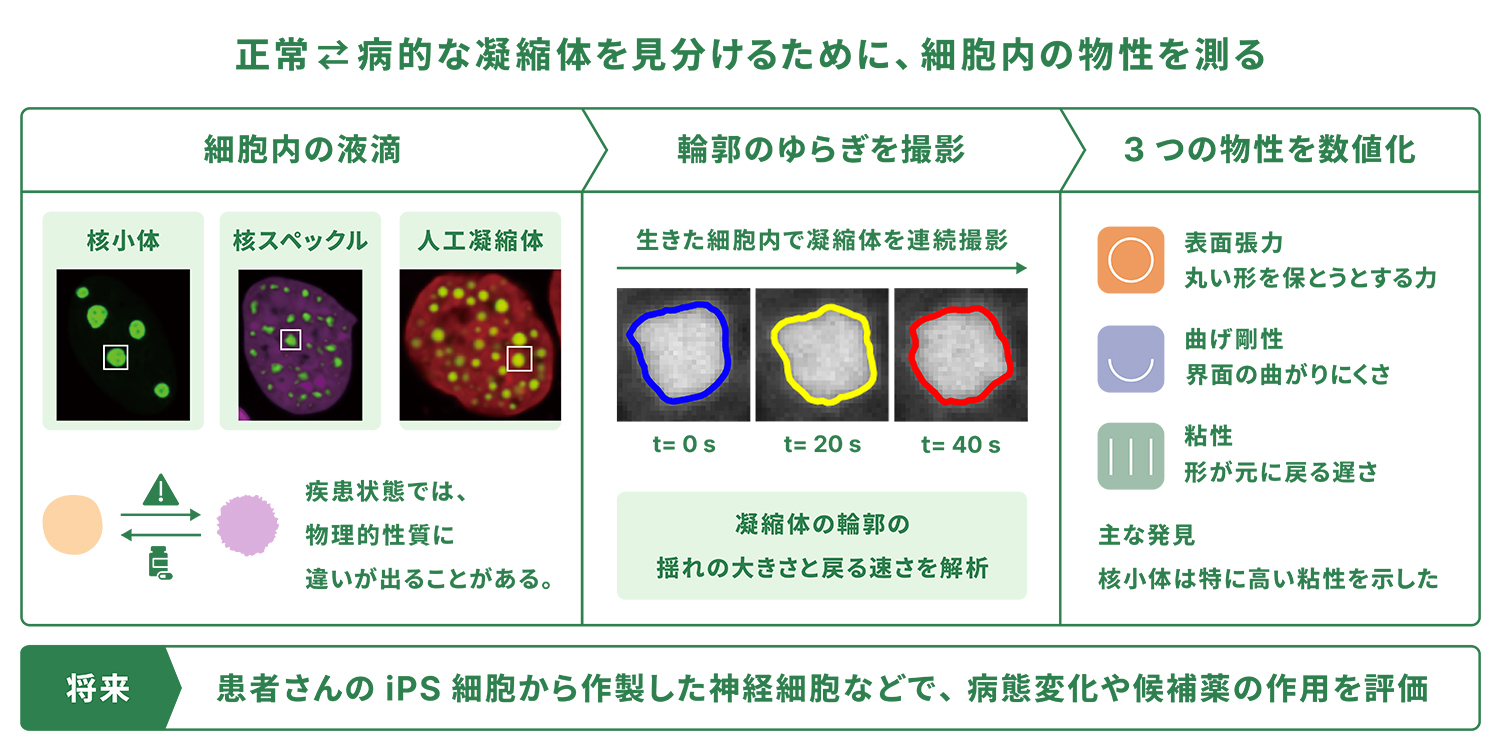
Abstract
Biomolecular condensates formed by phase separation are key players in cellular organization, yet their interfacial mechanics remain poorly understood. Here we show that both synthetic and endogenous nuclear condensates exhibit critical-like interfacial behaviors near the phase boundary, including enhanced capillary fluctuations and reduced surface tension. By combining optogenetic control with submicron-resolution fluctuation spectroscopy, we quantitatively estimate surface tension, bending rigidity, and effective viscosity. Surface tension diminishes as the system approaches the critical composition, consistent with classical theories of phase separation. Notably, bending elasticity emerges as an unexpected feature of these nuclear liquidlike structures, suggesting the formation of structured interfacial layers that progressively weaken near criticality. Among these condensates, the nucleolus displays exceptionally high viscosity, which may arise in part from viscoelastic coupling to the surrounding perinucleolar heterochromatin, effectively increasing the apparent viscosity in the long-time fluctuation regime. This noninvasive approach enables probing condensate mechanics in living cells and may provide a basis for diagnosing or modulating condensates in biomedical contexts.