2026-09-18 京都大学iPS細胞研究所
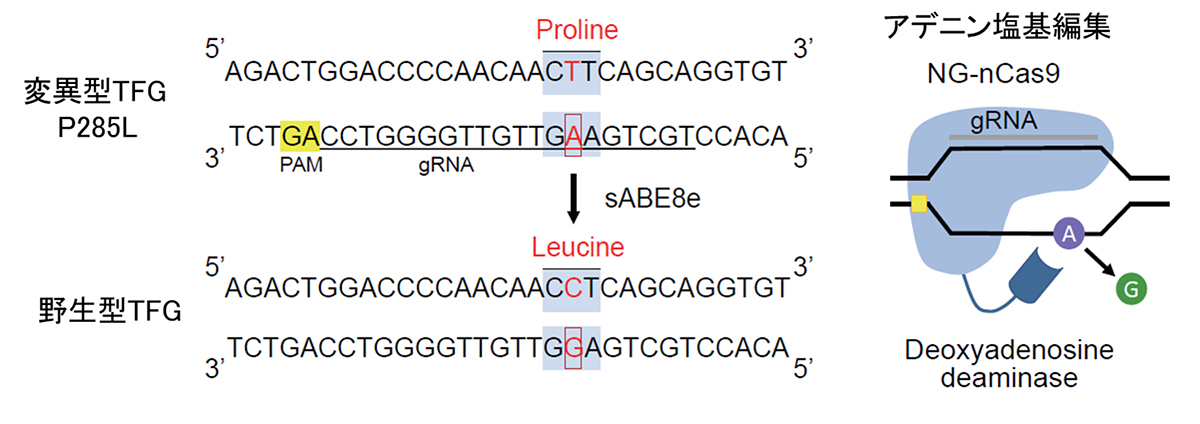
図1 塩基編集の模式図
アデニン塩基編集酵素(右図:濃い青の部位)を用いて、変異部位の塩基をアデニン(A)からグアニン(G)に変換し修復する。
<関連情報>
- https://www.cira.kyoto-u.ac.jp/j/pressrelease/news/260918-100000.html
- https://www.cell.com/molecular-therapy-family/advances/fulltext/S3117-387X(26)00170-9
塩基編集により、マウスおよび患者由来iPSCオルガノイドモデルにおける遺伝性運動ニューロン疾患が改善する Base editing rescues a hereditary motor neuron disease in mouse and patient-derived iPSC organoid models
Keiko Imamura ∙ Shin Yoshioka ∙ Kota Kamizato ∙ … ∙ Keiji Nishida, ∙ Yuishin Izumi ∙ Haruhisa Inoue
Molecular Therapy Advances Published:August 21, 2026
DOI:https://doi.org/10.1016/j.omta.2026.201835
Abstract
In hereditary motor neuron diseases (MNDs), including forms of amyotrophic lateral sclerosis (ALS) caused by single-nucleotide variants, effective therapeutic strategies need to address both gain- and loss-of-function mechanisms. Genome editing-based gene therapy represents a promising approach for simultaneously targeting these mechanisms. To establish proof-of-concept for base editing in a hereditary MND, we targeted the P285L variant in the TRK-fused gene (TFG), which causes hereditary motor and sensory neuropathy with proximal dominant involvement (HMSN-P), a disorder that shares clinical and histopathological features with ALS. We identified the optimal adenine base editor by comparing candidate editors in HMSN-P patient-derived induced pluripotent stem cells (iPSCs). We then generated a transgenic mouse model expressing human TFG P285L and evaluated the selected editor by subpial delivery of adeno-associated virus (AAV) vectors to the spinal cord. AAV-mediated base editing prolonged survival, preserved motor neurons, and attenuated axon loss in ventral nerve roots. Treatment with the selected base editing vector reduced TFG aggregation and suppressed neuronal death in HMSN-P iPSC-derived neuromuscular organoids. Collectively, these findings support the therapeutic potential of base editing for hereditary MNDs.