2026-10-05 ワシントン大学セントルイス校
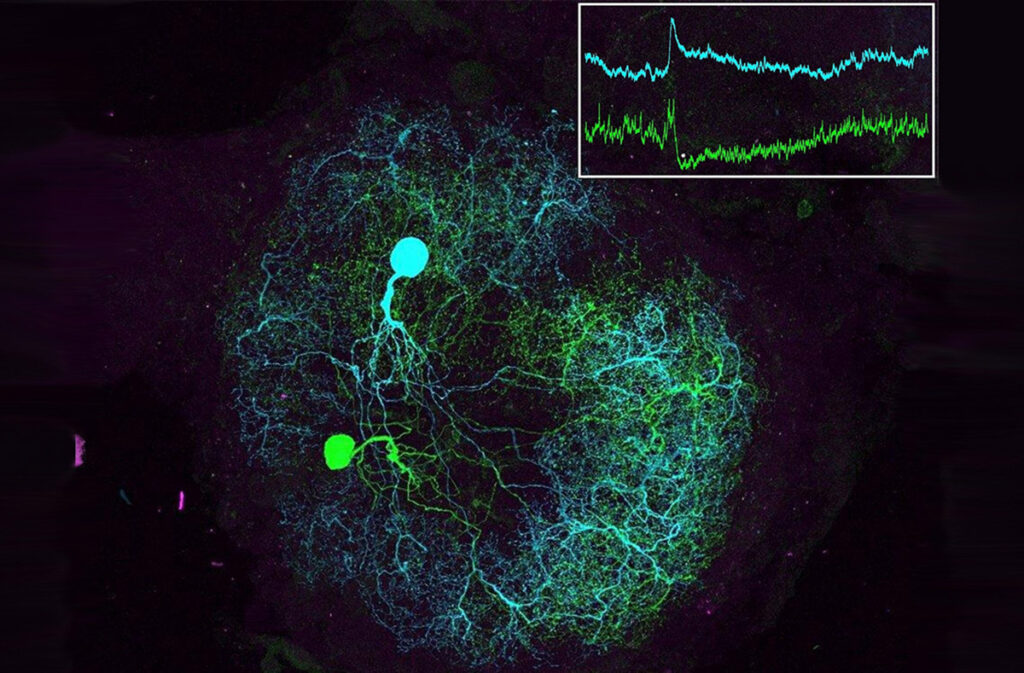
Histological images of depolarizing and hyperpolarizing local neurons that modulate the overall activity of the antennal lobe neural network that processes sensory input from the insect antenna. (Image: Raman lab)
<関連情報>
- https://source.washu.edu/2026/10/what-a-locust-can-teach-us-about-how-neuromodulators-alter-odor-processing/
- https://www.jneurosci.org/content/early/2026/09/11/JNEUROSCI.2338-25.2026
昆虫の嗅覚モデルにおけるドーパミンとオクトパミンの拮抗作用を媒介する異なるメカニズム Distinct mechanisms mediate dopamine-octopamine opponency in an insect model of olfaction
Yelyzaveta Bessonova, Ivy Clark, Ryan Sumida, Jacob Kelley, Ishaan Alva and Barani Raman
Journal of Neuroscience Published:14 September 2026
DOI:https://doi.org/10.1523/JNEUROSCI.2338-25.2026
Abstract
Neuromodulators play a key role in determining how an organism processes and responds to sensory cues. Often, different neuromodulators act on the same set of neural circuits to produce diverging behavioral outcomes. In this study, we examined how dopamine and octopamine alter odor-driven neural activity in a peripheral olfactory circuit (the antennal lobe) of the locusts (Schistocerca americana, both sexes) and thereby alter behavioral responses in an opposing manner. Our results indicate that dopamine suppressed GABAergic local neuron activity during odor stimulation. Releasing the antennal lobe network from inhibition increased the principal neural activity for all odorants and led to nonspecific increases in a behavioral appetitive response. Octopamine, on the other hand, did not alter the GABAergic inhibition in the antennal lobe but still reduced the odor-evoked principal neural activity and the behavioral responses elicited by all odorants. Thus, both dopamine and octopamine used distinct mechanisms (altering recurrent inhibition vs intrinsic excitability) to mediate opponent changes in odor-evoked neural activity and behavioral outcomes.