
2026-10-15 中国科学院(CAS)
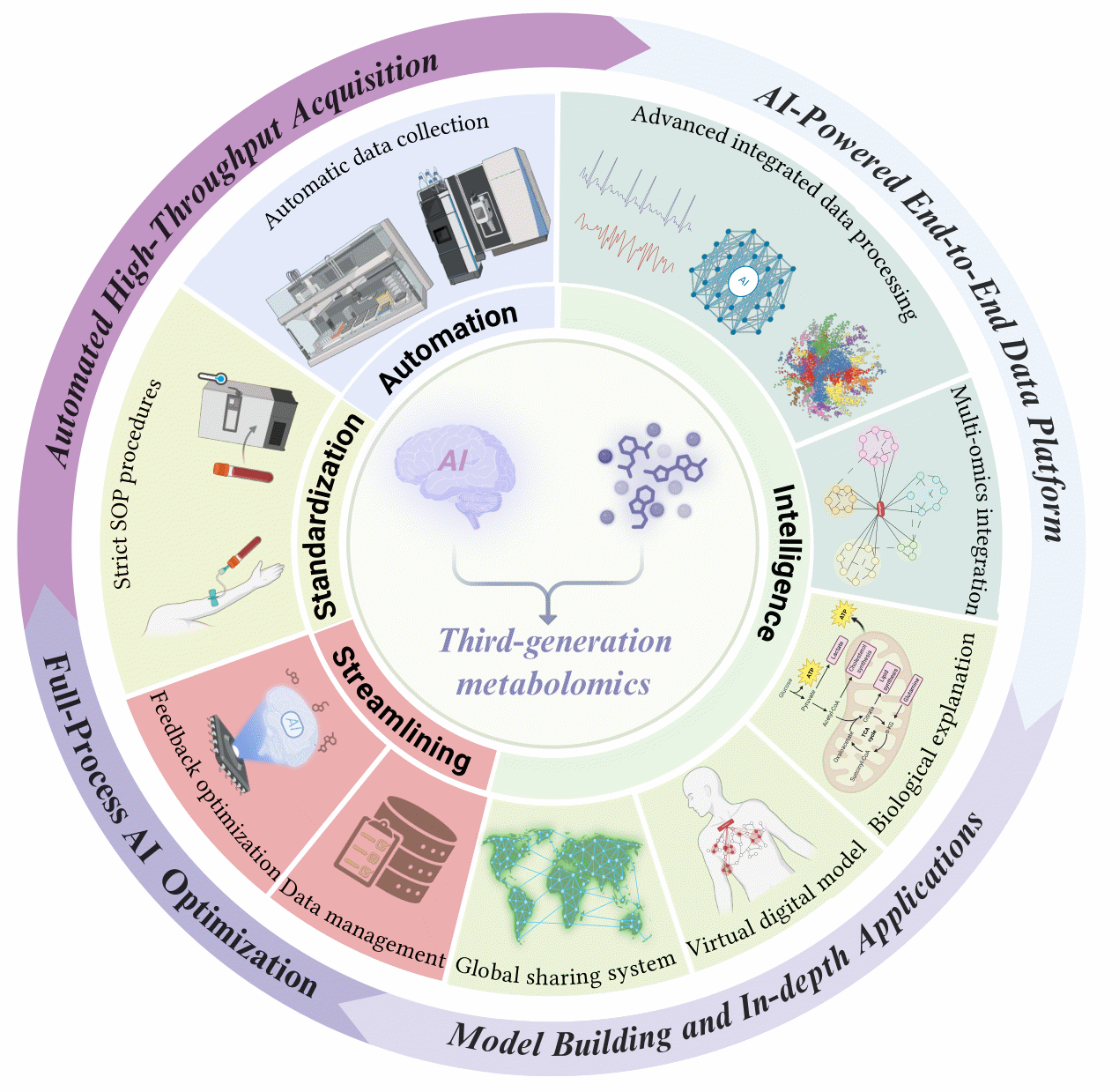
Agent-driven third-generation metabolomics unifies standardization, automation, intelligence, and streamlining to enable closed-loop automation and systems biology integration. (Image by JING Fengyang)
<関連情報>
- https://english.cas.cn/newsroom/research-news/202610/t20261015_1203833.shtml
- https://www.sciencedirect.com/science/article/abs/pii/S0165993626005455
人工知能を活用した質量分析法に基づくメタボロミクス:現状と将来展望 Artificial intelligence-enabled mass spectrometry-based metabolomics: current status and future prospects
Fengyang Jing, Mingchao Wang, Liliang Wen, Xinyu Liu, Guowang Xu
TrAC Trends in Analytical Chemistry Available online: 10 October 2026
DOI:https://doi.org/10.1016/j.trac.2026.119188
Highlights
- The evolution and critical bottlenecks of metabolomics are systematically examined.
- AI enables optimization across the metabolomics workflow.
- “Third-generation metabolomics” integrates standardization, streamlined workflow, automation, and intelligence.
- “Lights-out labs” and “Metabolome-centered digital twins” are frontiers of metabolomics.
Abstract
Metabolomics is the study of small-molecule metabolites within living organisms, which reflects the physiological and pathological states of a biological system at a specific time. High resolution mass spectrometry (HRMS) is one of the most useful tools for untargeted metabolomics analysis. Although great advances have been achieved, many challenges still exist in peak matching and batch effects for a large number of samples, structural annotation and identification of features, and reproducibility and standardization etc. In this perspective, we review the advances and limitations of current metabolomics with a primary focus on biomedical applications, summarize artificial intelligence (AI)-enabled metabolomics, and propose a new framework of the “Third-generation metabolomics”. The latter approach, by integrating automated instruments with AI, enables standardization, streamlined workflow, automation, and intelligent operations. Based on this, AI-based “Lights-Out” laboratories will provide high-quality data which is helpful to construct “Metabolome-centered Digital Twins” and promote the transition from descriptive phenotyping to predictive simulation, thereby providing a basis for precision medicine and a systemic understanding of biological complexity.

