2026-11-06 京都大学iPS細胞研究所
京都大学iPS細胞研究所の研究グループは、ヒトiPS細胞から視床下部・下垂体オルガノイドを効率よく作製する分化誘導法を開発した。着目したのは、iPS細胞の未分化状態を維持するために用いるフィーダー細胞の種類による分化特性の違いである。SNL細胞は口腔外胚葉系、マウス胎児線維芽細胞(MEF)は神経外胚葉系への分化を促す傾向があることを確認した。そこで両者を適切な比率で混合してiPS細胞を培養したところ、オルガノイド内の視床下部細胞と口腔外胚葉細胞の構成バランスが改善し、下垂体前駆細胞への分化効率が向上した。さらに、安定型bFGF変異体(FGF2-G3)を導入し、培地交換を週3回に減らすとともに、週末の交換を不要とする「Weekend-free分化誘導法」を確立した。この方法でも下垂体ホルモン産生細胞への分化効率は従来法と同程度に維持された。本成果は、長期培養の負担を軽減し、下垂体の発生・疾患研究や再生医療研究を効率化する基盤技術となることが期待される。
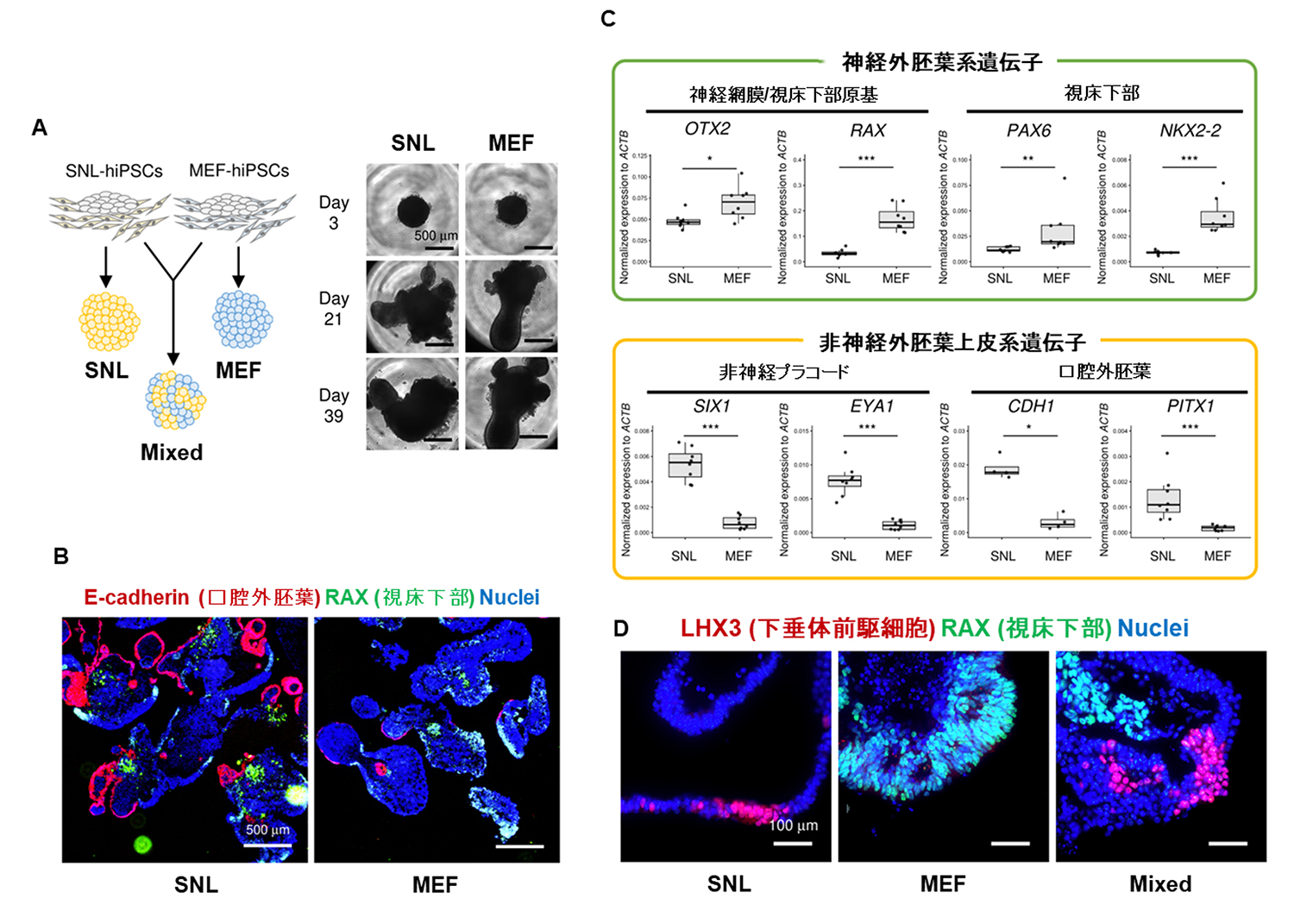
図1 フィーダー細胞の種類による分化嗜好性の違い
A. SNLとMEFフィーダー細胞で培養したiPS細胞からの視床下部ー下垂体オルガノイド形成
B. SNLとMEFフィーダー細胞で培養したiPS細胞から誘導した視床下部ー下垂体オルガノイドの蛍光免疫染色(培養21日目)
C. 神経外胚葉系遺伝子と非神経外胚葉上皮遺伝子の定量的PCR(培養21日目)
D. SNLとMEFで培養したiPS細胞を混合した際の蛍光免疫染色(培養39日目)
<関連情報>
最適化されたフィーダー依存性培養により、ヒト多能性幹細胞からの視床下部-下垂体オルガノイドの効率的な誘導が可能になる
Optimized feeder-dependent culture enables efficient hypothalamic-pituitary organoid induction from human pluripotent stem cells
Ryusaku Matsumoto ∙ Ayaka Nishio ∙ Takuya Yamamoto
Stem Cell Reports Published:November 5, 2026
DOI:https://doi.org/10.1016/j.stemcr.2026.103145
Highlights
•Maintenance culture conditions affect pituitary organoid induction efficiency
•MEF feeders promote hypothalamic lineages and SNLs favor oral ectodermal lineages
•Combining both feeders improves lineage balance and pituitary induction efficiency
•A “weekend-free” protocol was developed while maintaining induction efficiency
Summary
Human pluripotent stem cell (hPSC)-derived hypothalamus-pituitary organoids recapitulate key processes of pituitary development in vitro, where cellular interactions between hypothalamic and oral ectodermal lineages are essential for organoid formation. However, how maintenance culture conditions for hPSCs influence the processes of lineage specification remains unclear. Here, we demonstrate that feeder-dependent culture conditions critically determine lineage specification during organoid formation. hPSCs maintained on SNL feeders preferentially differentiated into oral ectodermal cells, whereas maintenance on MEF feeders favored hypothalamic lineages. Co-culturing SNL- and MEF-maintained hPSCs or combining their conditioned media effectively balanced these lineages, enhancing pituitary induction efficiency. Furthermore, a stabilized FGF2 mutant enabled a “weekend-free” protocol that reduced labor and cost while maintaining high differentiation efficiency. Our findings underscore the significance of maintenance conditions and hypothalamus-oral ectoderm interactions in pituitary development, establishing a robust platform for efficient and reproducible generation of hypothalamus-pituitary organoids.