
2026-10-19 埼玉大学
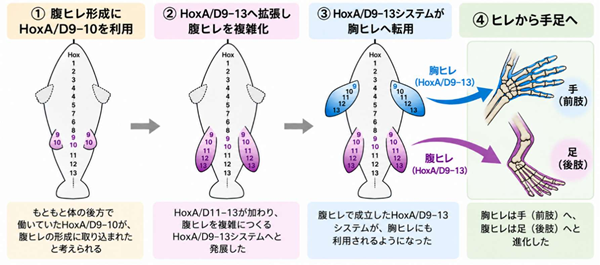
図1
<関連情報>
- https://www.saitama-u.ac.jp/topics_archives/202610191000.html
- https://www.pnas.org/doi/10.1073/pnas.2621291123
保存されたHox9–10遺伝子コードが、ゼブラフィッシュとイベリアイモリの後肢前駆細胞の初期形成の基盤となっている A conserved Hox9–10 code underlies the early establishment of hind appendage progenitors in zebrafish and the Iberian ribbed newt
Hidemichi Nakazawa, Kohei Urakawa, Akiteru Maeno, +9 , and Akinori Kawamura
Proceedings of the National Academy of Sciences Published:October 16, 2026
DOI:https://doi.org/10.1073/pnas.2621291123
Abstract
The acquisition of paired appendages was a key innovation in vertebrate evolution. Although HoxA/D paralog groups (PGs) 9–13 play central roles in patterning paired fins and limbs, the evolutionary origin of this paired appendage-patterning system remains unknown. Here, we show that HoxA/D PG9–10 genes are essential for the early establishment of pelvic fin progenitors in zebrafish, and that Hox9–10 function is similarly required for hindlimb progenitor formation in the Iberian ribbed newt. In zebrafish, combined disruption of five HoxA/D PG9–10 genes abolishes the detectable pelvic fin progenitor population, resulting in complete loss of pelvic fins. A Tg(hoxa10b:EGFP) reporter labeled cells in the presumptive pelvic fin field before pelvic fin bud formation. Importantly, simultaneous CRISPR-mediated disruption of all seven Hox9–10 paralogs in the Iberian ribbed newt similarly impaired the establishment of hindlimb progenitors, suggesting that an early requirement for Hox9–10 function in hind appendage development predates the divergence of ray-finned and lobe-finned vertebrates. Together, these findings identify an evolutionarily conserved role for posterior Hox9–10 genes in the initial establishment of hind appendage progenitors. Because overlapping posterior Hox paralog groups are subsequently deployed during paired appendage patterning, this early Hox9–10 requirement provides a developmental link between the posterior axial Hox code and the paired appendage-patterning system. Our results are therefore consistent with the hypothesis that recruitment of a posterior Hox code into hind appendage progenitor formation contributed to the evolutionary assembly of the vertebrate paired appendage-patterning system.

