2026-10-22 中国科学院(CAS)
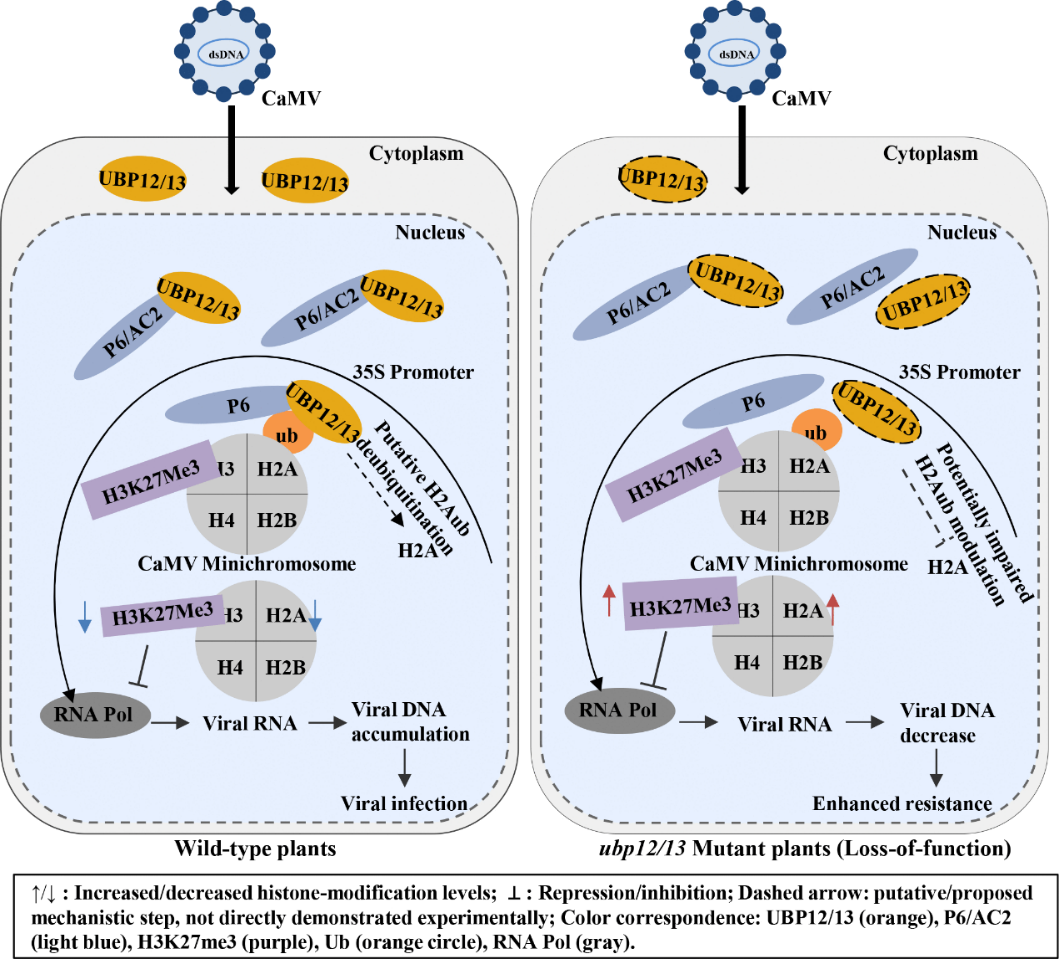
Proposed working model illustrating how CaMV P6 exploits UBP12/13 to alleviate host epigenetic silencing and promote viral infection. (Image by LI Shun)
<関連情報>
- https://english.cas.cn/newsroom/research-news/202610/t20261022_1209260.shtml
- https://journals.plos.org/plospathogens/article?id=10.1371/journal.ppat.1014686
DNAウイルスの病原性因子は、シロイヌナズナの脱ユビキチン化酵素UBP12/13と相互作用してウイルス感染を促進する The pathogenicity factor of DNA virus interacts with Arabidopsis deubiquitinases UBP12/13 to promote viral infection
Shun Li,Fangqin Yu,Yi Zhang,Siqi Liu,Hui-Wen Wu,Nam-Hai Chua,Shulin Deng
Pathogens Published: October 15, 2026
DOI:https://doi.org/10.1371/journal.ppat.1014686
Abstract
Plant DNA viruses, such as Cauliflower mosaic virus (CaMV) and Cabbage leaf curl virus (CaLCuV), are devastating pathogens that cause substantial yield losses in crops worldwide. These viruses assemble their genomes into minichromosomes with host histones. Histone post-translational modifications (PTMs) are important for viral replication and host resistance. In this study, we demonstrate that the CaMV pathogenicity factor P6 interacts with Arabidopsis deubiquitinases UBP12 and UBP13, which are typically negative regulators of plant immunity. Using affinity purification–mass spectrometry (AP-MS), we identified UBP12/13 as prominent P6 interactors and confirmed their nuclear association. CaMV infection and P6 overexpression increased UBP12 abundance, suggesting the latter promotes viral infection. By contrast, ubp12/13 mutants exhibited enhanced resistance, characterized by reduced accumulation of viral DNA and transcripts. Chromatin immunoprecipitation (ChIP)-qPCR showed that the monoubiquitinated H2A (H2Aub) and H3K27me3 modifications on the CaMV 35S promoter, but not the 19S promoter, were significantly elevated in ubp12/13 mutants compared with wild-type plants. Furthermore, UBP12/13 are also targeted by AC2, a transcriptional activator from CaLCuV, indicating a conserved strategy among plant DNA viruses. Our findings support a working model in which viral pathogenicity factors hijack UBP12/13, which in turn may alter H2Aub homeostasis on viral minichromosomes to relieve epigenetic silencing and promote infection. Together, these findings point to a previously unrecognized route by which plant DNA viruses may influence host chromatin-associated pathways and identify UBP12/13 as potential targets for engineering virus-resistant crops.